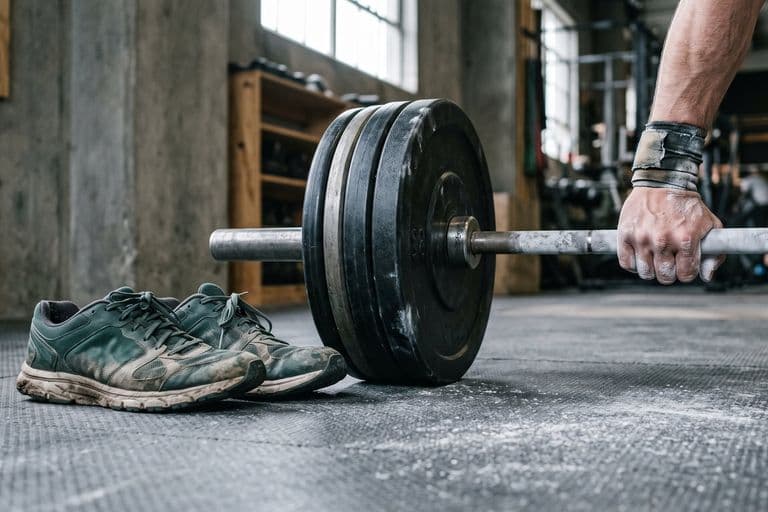
The objection is always the same. Lifting makes you heavy, heavy makes you slow, and time in the gym is time not spent running. It is a reasonable worry and it is mostly wrong — because the strength work that serves a runner looks nothing like the strength work that builds a bodybuilder.
What strength training actually does for a runner
Three things, in rough order of how confident we can be about them.
It makes you harder to injure
Most running injuries are not accidents. They are the result of the same tissue absorbing the same load thousands of times a week without ever being asked to do anything else. Loading a tendon or a muscle deliberately, under control, in the gym is how you increase what it can tolerate. This is the least controversial benefit of strength work for runners and the one most worth turning up for.
It improves running economy
Running economy is how much oxygen you need to hold a given pace. Heavy strength work and explosive work both appear to improve it, which means the same effort produces a faster pace. The size of the effect varies a lot between individuals, and it is not a substitute for running — but for an athlete who has never lifted, it is real.
It keeps your form together when you are tired
The last third of a race is where technique falls apart: hips drop, cadence falls, ground contact lengthens. Strength does not stop fatigue, but a stronger athlete arrives at that point with more margin. Anyone who has watched their own late-race splits knows what this is worth.
Almost nobody gets slower because they got stronger. Plenty of people get injured because they never did.
Why it will not make you bulky
Building meaningful muscle mass requires a calorie surplus, high training volume in a hypertrophy rep range, and a lot of patience. A runner doing two sessions a week of heavy, low-rep work while running five times a week has none of those conditions. You will get stronger. You will not get bigger in any way that costs you.
The exception worth naming: if you deliberately train for size, in a surplus, you will gain size. That is a choice, not an accident.
How much is enough
- Two sessions a week is the sensible target for most runners in most phases.
- One session a week maintains what you have and is far better than nothing during a heavy running block.
- Three or more starts to compete with running for recovery unless your mileage is low.
Sessions do not need to be long. Thirty to forty minutes of focused work beats ninety minutes of wandering between machines.
What to actually do
A runner’s strength session should cover a squat pattern, a hinge pattern, a single-leg movement, and something for the calves and feet. Heavy, low reps, long rests.
- Squat or split squat — 3–4 sets of 4–6 reps.
- Deadlift or Romanian deadlift — 3 sets of 4–6 reps.
- Single-leg work — step-ups or rear-foot-elevated split squats, 3 sets of 6–8 per side.
- Calf raises — 3 sets of 8–12, straight leg and bent knee.
- Something for the trunk — a plank variation or a carry, 3 sets.
Where it fits in the week
The general rule: put strength work on a day you are already working hard, not on an easy day. Stacking hard on hard leaves easy days genuinely easy, which is where the adaptation happens. If you lift on the same day as a quality run, run first.
Leave at least a day between a heavy lower-body session and a key running session. In the last two weeks before a goal race, reduce volume but keep lifting — stopping entirely is how you arrive at the start line feeling flat.
Common questions
Will strength training slow me down?
Not if it is programmed for strength rather than size. Heavy, low-rep work builds force production without meaningful mass gain, and the evidence on running economy points the other way.
Should I lift before or after running?
If both are in the same session, do the one that matters most for your goal first. For most runners in most weeks, that is the run.
Do I need a gym?
Eventually, yes, if you want to load heavily. You can make real progress at home with single-leg work and calf raises, but there is a ceiling on bodyweight training that a barbell removes.